A Nationwide Enrollment Freeze for DMEPOS Providers
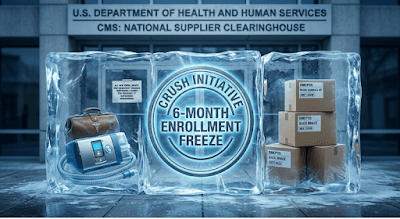
On February 27, 2026, CMS enacted a six-month nationwide moratorium on new Medicare enrollments for select DMEPOS categories under the CMS-6099-N notice.
This means:
No new PTANs (Medicare billing numbers) will be issued for affected categories
Applications submitted after the effective date will be denied outright
The moratorium is expected to remain in place through at least August 2026
This freeze does not just affect new businesses. It also impacts:
Providers expanding into new locations
Organizations undergoing ownership changes requiring re-enrollment
Suppliers attempting to add new DMEPOS service lines
For many pharmacies and DMEPOS providers, what was once a routine expansion process has effectively become paused at the federal level.
The “CRUSH” Initiative: Real-Time Data Enforcement
At the core of this shift is what many in the industry are referring to as the CRUSH initiative—a move toward real-time, cross-agency data enforcement.
Historically, Medicare (federal) and Medicaid (state) systems operated with limited coordination. That separation allowed inconsistencies in reporting to go unnoticed for extended periods.
That gap has now closed.
CMS is actively using advanced analytics and automated data matching to compare:
Medicare billing activity
State-level tax filings
1099 income reporting
Operational and staffing data
If discrepancies are detected—such as reported income not aligning with billing volume—the system can trigger immediate audit activity.
This represents a fundamental shift from reactive enforcement (“pay and chase”) to proactive claim monitoring and denial.
The Medicaid Spillover Effect: Multi-State Risk Exposure
One of the most significant implications of the CRUSH initiative is how quickly compliance issues can now spread across payer systems.
If a provider is flagged at the Medicare (federal) level, that information can now be shared directly with state Medicaid agencies.
This creates a cascading risk:
A Medicare discrepancy can trigger state-level investigations
Medicaid reimbursement can be delayed, reduced, or suspended
Commercial payer contracts may also be impacted
Recent enforcement activity has already demonstrated the scale of this shift. In one case, CMS deferred hundreds of millions in Medicaid funding after identifying billing anomalies that state systems failed to catch in time.
Examples of flagged patterns included:
Billing volumes inconsistent with reported staffing levels
Claims suggesting impossible operational capacity (e.g., continuous 24-hour billing over extended periods)
For providers, this means compliance is no longer siloed. A single issue can now affect every payer relationship simultaneously.
States Currently Under Heightened Oversight
Providers operating in the following regions should be especially cautious, as these states are currently seeing increased scrutiny under coordinated federal and state oversight efforts:
Northeast
Connecticut, Maine, Massachusetts, New Hampshire, New Jersey, New York, Pennsylvania, Rhode Island, Vermont
South
Alabama, Florida, Georgia, Kentucky, Louisiana, Maryland, Mississippi, North Carolina, South Carolina, Virginia, West Virginia
Midwest
Illinois, Indiana, Michigan, Minnesota, Ohio
West
Arizona, California, Nevada
Territories
United States Virgin Islands
If your pharmacy or DMEPOS operation spans multiple states, maintaining consistent, accurate reporting across all jurisdictions is now essential.
The 36-Month Rule: A Hidden Barrier to Ownership Changes
Another critical compliance issue is the 36-month rule, which has taken on new importance under the current moratorium.
As of January 1, 2026:
If your organization has been enrolled in Medicare for less than 36 months
And you transfer more than 50% ownership
CMS may classify the change as a new enrollment.
Under normal conditions, this would trigger a re-enrollment process. However, due to the current moratorium:
New enrollments are blocked
The ownership transition may be effectively prevented
This creates a serious constraint for:
Business sales
Partnerships or equity restructuring
Expansion through acquisition
For affected organizations, ownership flexibility is now directly tied to regulatory timing and compliance status.
What to Expect Next: Real-Time Enforcement Is Here
CMS is continuing to move toward a real-time compliance environment.
Emerging enforcement trends include:
Shortened documentation and filing windows
Increased pre-payment claim reviews
Automated claim denials for incomplete or inconsistent data
Greater reliance on data validation across systems before approval
The traditional model of submitting claims and resolving issues later is being replaced by front-end enforcement, where claims may be denied before payment is ever issued.
For pharmacies and DMEPOS providers, this means:
Documentation must be accurate and complete at submission
Accreditation records must align exactly with billed services
Enrollment data must remain fully synchronized across all systems
Any gap in these areas can result in delayed payments, denied claims, or enrollment actions.
How PACCS Helps Pharmacies Navigate CMS Enforcement Changes
As Medicare and Medicaid oversight becomes more complex, maintaining compliance across multiple systems and timelines requires ongoing attention and expertise.
PACCS (Pharmacy Accreditation Compliance Credentialing Solutions) supports pharmacies and DMEPOS providers with:
Medicare and Medicaid enrollment management
DMEPOS credentialing and accreditation coordination
Ownership change and re-enrollment strategy
NPI, PECOS, and payer data alignment
Ongoing compliance monitoring and deadline tracking
Payer communication and issue resolution
By proactively managing enrollment data and compliance requirements, PACCS helps organizations avoid disruptions, protect billing privileges, and maintain operational continuity.
To learn more, visit our Services page or contact PACCS to discuss how we can support your pharmacy or DMEPOS operation.
Sources
https://www.federalregister.gov/documents/2026/02/27/2026-03945/medicare-medicaid-and-childrens-health-insurance-programs-provider-enrollment-application-fee-and&authuser=1
https://www.cms.gov/newsroom/press-releases/trump-administration-prioritizes-affordability-announcing-major-crackdown-health-care-fraud
https://hallrender.com/2026/02/12/36-month-rule-applies-to-dmepos-suppliers-effective-january-1-2026/
https://hallrender.com/2026/03/06/cms-issues-sweeping-anti-fraud-rfi-under-new-crush-initiative/
https://www.cms.gov/outreach-and-education/medicare-learning-network-mln/mlnproducts/downloads/dmepos_basics_factsheet_icn905710.pdf
Investigative Dispatch — PACCS Editorial Series
Insights on regulatory developments affecting pharmacy credentialing, Medicare enrollment, and compliance.
Sterling Bly | Investigative Healthcare Blogger