Why NPI and Taxonomy Alignment Matters More Than Ever
Commercial payers have shifted toward automated claim validation systems that rely heavily on provider data.
Before a claim is paid, systems now verify:
Rendering provider (Type 1 NPI)
Billing entity (Type 2 NPI + TIN)
Taxonomy code (provider specialty classification)
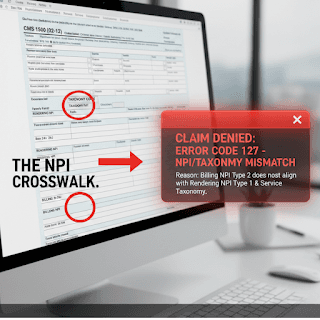
If any of these elements do not align with the payer contract or federal registry data (NPPES), the claim may be:
Automatically denied
Flagged as out-of-network
Delayed for manual review
In many cases, providers believe they are contracted and compliant—yet revenue is disrupted due to technical misalignment, not clinical issues.
Understanding the Type 1 NPI (Individual Provider)
A Type 1 NPI is a unique, permanent identifier assigned to an individual healthcare professional.
For pharmacies and DMEPOS providers, this includes:
Pharmacists
Clinicians
Specialists performing services
On a claim, the Type 1 NPI is used as the Rendering Provider, meaning:
The individual who personally performed the service
The professional whose credentials and licensure are being validated
In 2026, payers are using this identifier to confirm:
The provider has the appropriate credentials
The service billed is within their legal scope of practice
Licensure and certifications are current and valid
If the rendering NPI does not meet these criteria, the claim may be rejected—even if everything else is correct.
Understanding the Type 2 NPI (Organization / Billing Entity)
A Type 2 NPI represents the business entity—such as a pharmacy, DMEPOS supplier, or group practice.
This NPI is used as the Billing Provider and is tied to:
The organization’s Tax ID (TIN)
Ownership structure
Contractual agreements with payers
This is the entity that:
Submits claims
Receives reimbursement
Holds payer contracts
A common and costly error occurs when:
A payer contract is linked to a Type 1 NPI instead of the Type 2 NPI
Claims are submitted under the organization’s TIN, but the contract is tied incorrectly
This mismatch can result in:
System-wide claim denials
Payment delays
The provider being treated as out-of-network, despite having a signed agreement
To prevent this, providers should regularly verify their records in the NPPES (NPI Registry) and ensure all data aligns with payer contracts.
The Taxonomy Code Problem: A Silent Cause of Denials
Even with the correct NPI structure, claims can fail if the taxonomy code does not match the billed service.
A taxonomy code is a 10-character alphanumeric identifier that defines your provider specialty.
Examples include:
Retail Pharmacy Taxonomy: 3336C0003X
DMEPOS Supplier Taxonomy: (varies based on classification)
In 2026, payers are enforcing stricter taxonomy-to-service validation.
If a provider:
Bills DMEPOS items
But is registered under a retail pharmacy taxonomy
The system may determine that:
The service is outside the provider’s defined specialty
The claim is invalid under the contract
These denials often occur silently and repeatedly until the mismatch is corrected.
The Three-Way Alignment Required for Clean Claims
To avoid denials and maintain payer alignment, providers must ensure a three-way match across all identifiers:
1. Rendering Provider
Type 1 NPI matches the individual performing the service
2. Billing Entity
Type 2 NPI aligns with the organization’s Tax ID and contract
3. Taxonomy Code
Matches the services being billed and the payer agreement
All three must be:
Consistent with NPPES records
Reflected correctly in payer systems
Aligned with the contracted scope of services
If even one element is misaligned, claims can be denied before payment is issued.
Real-Time Validation: Why Errors Are Caught Instantly
Payers are no longer relying on manual audits to catch discrepancies.
Instead, they use:
Automated NPI-to-taxonomy crosswalks
Real-time validation against federal databases (NPPES)
Contract-level verification tied to billing entities
This means:
Errors are caught immediately at claim submission
There is often no opportunity to correct issues retroactively
Repeated denials can impact cash flow and payer relationships
For providers, this requires a shift toward proactive data management, not reactive troubleshooting.
Best Practices for NPI and Taxonomy Compliance
To maintain clean claims and consistent reimbursement, providers should:
Regularly audit NPPES records for accuracy
Ensure all relevant taxonomy codes are listed and active
Confirm payer contracts are tied to the correct Type 2 NPI
Validate that rendering providers are properly linked to services
Align internal systems with payer and federal data requirements
These steps reduce the risk of denials caused by technical misalignment, which is increasingly common in 2026.
How PACCS Supports Commercial Credentialing & Data Alignment
Managing NPI structures, taxonomy codes, and payer contracts requires ongoing attention—especially as validation systems become more automated.
PACCS (Pharmacy Accreditation Compliance Credentialing Solutions) helps pharmacies and DMEPOS providers maintain accurate, aligned provider data by offering:
Commercial payer credentialing and contract alignment
NPI (Type 1 & Type 2) setup and validation
Taxonomy code selection and optimization
NPPES and PECOS data management
Ongoing compliance monitoring and updates
Payer communication and denial resolution
By ensuring your provider data is consistent across all systems, PACCS helps protect your revenue cycle, contract integrity, and network visibility.
To learn more, visit our Services page or contact PACCS to discuss how we can support your organization.
Sources
https://nppes.cms.hhs.gov/#/
https://data.cms.gov/provider-characteristics/medicare-provider-supplier-enrollment/medicare-provider-and-supplier-taxonomy-crosswalk
Investigative Dispatch — PACCS Editorial Series
Insights on regulatory developments affecting pharmacy credentialing, Medicare enrollment, and compliance.
Sterling Bly | Investigative Healthcare Blogger